Deutsch
Rolling Bassinets: Wheel & Frame Checks for Importers
Erstellt 03.16
Bringing nursery furniture into the United States needs careful attention. You must ensure your cargo meets all federal regulations. This is crucial for importer compliance and long-term success.
rolling bassinet
Choosing a rolling bassinet means the frame's integrity is key. It must handle daily use while keeping the baby safe. A strong foundation is essential for earning trust from parents.
Our focus on bassinet safety helps us stand out in a competitive market. We check every joint and caster to ensure each bassinet is a reliable sanctuary for newborns. Our aim is to make inspections simple and effective for your team.
Key Takeaways
- Frame stability is the base for quality in infant products.
- Smooth wheel movement prevents tipping and boosts daily use.
- Meeting US federal standards protects your business from legal risks.
- Regular structural checks greatly lower recall chances.
- Strong locking mechanisms on all wheels are vital for safety.
- Using top-quality materials ensures the product lasts for years.
1. What We Need to Know About Rolling Bassinet Standards in the US
Rolling bassinets in the US must follow strict safety rules. These rules help keep babies safe and ensure they sleep well. As importers, knowing these rules is key to keeping children safe.
The US has two main groups that set these safety standards: the American Society for Testing and Materials (ASTM) and the Consumer Product Safety Commission (CPSC). Following these standards is a must for any business wanting to sell bassinets in the US.
ASTM F2194 Safety Standard Requirements
The ASTM F2194 standard covers many important aspects of bassinet safety. It looks at design, materials, and how well the bassinet works. Key areas include:
- Structural Integrity: Making sure the bassinet's frame and parts can handle normal and misuse.
- Stability: Testing if the bassinet can stay upright to prevent tipping.
- Entrapment and Suffocation Hazards: Designing the bassinet to reduce risks of getting trapped or suffocated.
Following ASTM F2194 is vital for making sure bassinets are safe. It's not just about meeting the minimum; it's about giving parents and caregivers a product they can trust.
CPSC Compliance for Bassinet Imports
The CPSC is key in making sure consumer products, like bassinets, are safe. CPSC compliance means following strict safety rules to protect consumers.
For bassinets, CPSC rules include:
- Following the ASTM F2194 standard.
- Providing detailed instructions for setting up, using, and keeping the bassinet in good shape.
- Making sure the product is safe and free from defects.
Why These Checks Protect Your Business
It's very important for your business to make sure bassinets meet ASTM F2194 and CPSC rules. Not following these rules can lead to expensive recalls, lawsuits, and harm to your brand's image.
By focusing on safety and compliance, you protect your customers and avoid financial and reputation losses. This shows you care about quality and keeping your customers safe.
2. Frame Structure and Integrity Inspection
We check the rolling bassinet's frame to make sure it's safe. This is key to seeing if it can handle the weight it's made for.
Evaluating Frame Materials and Construction
The materials of the bassinet's frame are very important. We look at their quality to make sure they're up to standard.
Metal Frame Quality Assessment
The metal frame is a key part of the bassinet. We look for any signs of weakness or damage, like rust, corrosion, or poor welding. We also check the metal's quality to see if it can handle daily use.
Welding and Joint Inspection Points
We check the welding and joints for any problems. This means looking for incomplete welds, porosity, or lack of fusion. It's important for the bassinet's stability.
Load-Bearing Capacity Verification
It's crucial to check if the bassinet can hold the weight it's made for. We do tests to make sure it can, without losing its shape.
Test Type | Description | Expected Outcome |
Static Load Test | Applying a static load to the bassinet to test its load-bearing capacity. | No deformation or collapse. |
Dynamic Load Test | Simulating real-world usage by applying dynamic loads. | The bassinet withstands the forces without failing. |
Stability and Anti-Collapse Features
It's important for the bassinet to be stable to avoid accidents. We look for features like a wide base and anti-collapse mechanisms. These ensure the bassinet stays stable.
By carefully checking the frame, we make sure the bassinet is safe. It meets all the safety standards needed.
3. Complete Wheel and Caster System Evaluation
Checking the wheel and caster system is key for safety and function in rolling bassinets. A good design ensures smooth movement and stability. These are vital for safe use.
Wheel Material and Durability Checks
The material and durability of the wheels are very important. They affect how well and safely the bassinet rolls. We look at the materials, like polyurethane or plastic, and their lasting power.
Polyurethane vs. Plastic Wheels
Polyurethane wheels are tough and last long. They give a smooth ride and are quiet. Plastic wheels are cheaper but not as durable. We consider weight capacity and floor type when choosing.
Wheel Diameter and Thickness Standards
The size and thickness of the wheels matter a lot. Bigger, thicker wheels handle different floors better and avoid damage. We make sure they meet standards and fit the use.
Locking Brake Mechanism Testing
A good locking brake is crucial for keeping the bassinet stable when not moving. We test it to make sure it works well. This includes checking the locking brake mechanism in different situations.
Swivel Function and Smooth Rolling
The swivel function makes moving the bassinet easy. Smooth rolling means it can be moved with little effort. We check the swivel and rolling on various floors for consistent performance.
Wheel Attachment Security
Lastly, we check if the wheels are securely attached. Loose or bad attachments can cause accidents. We ensure the attachment meets safety standards.
4. Our Step-by-Step Testing Protocol for Rolling Bassinets
Ensuring the safety and compliance of rolling bassinets is our top priority. We've developed a rigorous testing protocol. This process checks if every product meets the strict safety standards for the US market.
Our testing protocol has several key parts. Each part checks a different aspect of the bassinet's safety and how it works.
Visual Inspection Checklist
The first step is a detailed visual inspection. We look for any visible defects or non-compliances. This includes:
- Sharp edges or points
- Loose or missing parts
- Non-compliant labeling
- Surface finish issues
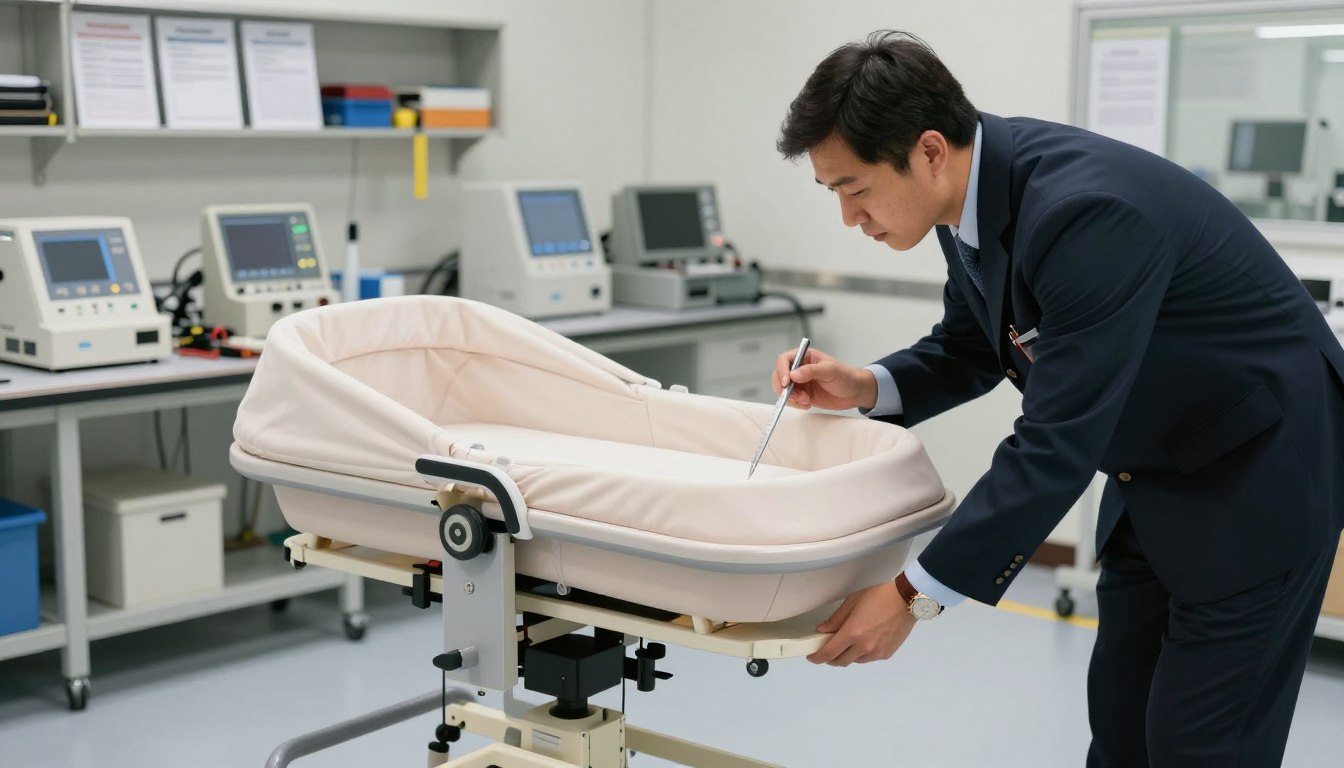
A detailed inspection scene of a rolling bassinet in a well-lit, spacious testing facility. In the foreground, a professional inspector in business attire is attentively examining the bassinet's wheel and frame, using a measuring tool. The bassinet is sleek and modern, with a soft, neutral color palette. In the middle ground, various testing equipment is neatly organized on a workbench, emphasizing the technical nature of the inspection process. The background features shelves stocked with safety compliance documents and tools, highlighting the environment's focus on quality assurance. Soft, diffused lighting illuminates the scene, creating a focused yet calm atmosphere, ideal for a thorough inspection. The camera angle is slightly elevated, capturing both the inspector's actions and the bassinet's details.
Functional Testing Procedures
After the visual inspection, we do a series of functional testing procedures. These tests check if the bassinet works as it should. The tests include:
Brake Engagement Test
We check if the braking system works well. It should hold the bassinet in place on different surfaces.
Rolling Resistance Test
This test checks how easy the bassinet is to roll. It should be neither too hard nor too easy.
Tip-Over Prevention Test
We test if the bassinet can tip over. It should be stable and prevent accidental tipping.
Safety experts say, "A product's safety is only as strong as its weakest link." Our testing protocol finds and fixes any weak spots.
Documentation Verification
Lastly, we check all necessary documents. This includes compliance certificates and user manuals. It makes sure our clients can show they meet all the rules. This way, they can offer safe and compliant products to their customers.
5. Critical Safety Components We Always Verify
We check many important safety parts in rolling bassinets. These parts help avoid accidents and keep the product safe.
Dual-Wheel Brake Systems
The dual-wheel brake system is a key safety feature. It stops the bassinet from rolling by accident. We make sure it works well and is reliable.
Key aspects of dual-wheel brake systems we check include:
- Effective engagement and disengagement mechanism
- Durability and resistance to wear and tear
- Ability to stop the bassinet on various floor types
Wide Base Stability Design
A wide base stability design is also crucial. It stops the bassinet from tipping over. This is important for safety, even when it's in use. We check if it meets safety standards.
Our checks for wide base stability design include:
- Measurement of the base width in relation to the height
- Testing the stability on different surfaces
- Evaluation of the weight distribution
Secure Mattress Board Connection
The mattress board must be securely attached. This prevents entrapment hazards. We make sure it's well attached to the bassinet frame.
We verify the following aspects of the mattress board connection:
- Secure fastening mechanism
- Stability during use
- Compliance with safety standards
Pinch Point and Entrapment Prevention
It's important to prevent pinch points and entrapment. We look for any hazards in the bassinet. This keeps the child safe.
Safety Feature | Inspection Criteria | Importance |
Dual-Wheel Brake | Effective braking, durability | Prevents accidental movement |
Wide Base Design | Base width, stability on surfaces | Prevents tip-overs |
Mattress Board Connection | Secure fastening, stability | Prevents entrapment |
6. Common Manufacturing Defects and Quality Issues
Our experience shows that some defects are common in rolling bassinets. It's important to fix these to keep quality high.
Frame Defects That Fail Inspection
Frame defects are a big problem. They can make a bassinet fail inspection. These issues harm both looks and safety.
Weak Welds and Joint Failures
Weak welds and joints can cause a bassinet to collapse. Inspectors check for uneven or incomplete welds.
Bent or Misaligned Frame Components
Bent or misaligned parts can make a bassinet unstable. It's key to ensure all parts fit right for safety.
Wheel and Caster Problems to Reject
Wheel and caster issues are common reasons for rejection. These problems can make the bassinet unsafe and hard to use.
Brake Mechanism Failures
A bad brake can cause accidents. Any brake failure is a big problem.
Loose or Wobbly Wheel Attachment
Loose or wobbly wheels can make a bassinet hard to move. It's important for wheels to be tight.
Surface Finish and Hardware Issues
Issues with surface finish and hardware can be safety risks. Even small problems can be dangerous.
Here's a quick list of common defects in rolling bassinets:
Defect Category | Specific Issue | Impact on Product |
Frame Defects | Weak Welds | Structural Integrity |
Frame Defects | Bent Components | Stability and Functionality |
Wheel and Caster Problems | Brake Mechanism Failures | Safety Risk |
Wheel and Caster Problems | Loose Wheel Attachment | Stability and Mobility |

A close-up view of a rolling bassinet on a factory assembly line, highlighting various manufacturing defects. In the foreground, focus on a bent wheel, misaligned frame joints, and uneven fabric seams to showcase quality control issues. In the middle, depict a worker in professional attire inspecting the bassinet with a clipboard, looking concerned about the defects. The background should feature a factory setting with machinery and assembly stations, softly illuminated by overhead fluorescent lights to emphasize a sterile, industrial atmosphere. The overall mood should convey a sense of urgency and attention to detail, illustrating the importance of thorough checks in manufacturing processes.
7. Conclusion
As we wrap up our talk on wheel and frame checks for rolling bassinets, it's clear that safety is key. Importers must follow strict safety rules to avoid problems. By doing so, they make sure their products are safe for babies.
We've shared a detailed testing plan and a way to check safety parts. This helps importers make sure their bassinets meet important safety standards. It's all about following the rules set by the ASTM F2194 and CPSC.
Putting safety first is important for businesses. It helps keep customers safe and builds trust. We urge importers to make these safety steps part of their quality checks. This way, they can help keep babies safe in the US.
FAQ
What are the primary safety standards we must follow when importing rolling bassinets to the United States?
We must follow ASTM F2194 safety standards and CPSC requirements. These rules cover the product's structure and safety. They make sure every product is safe for consumers.
How do we evaluate the integrity of the frame and welding during an inspection?
We check the metal frame quality and welding closely. We look for weak welds or misaligned parts. We also test the load-bearing capacity to ensure safety.
Why is the choice between polyurethane and plastic wheels important for rolling bassinets?
Polyurethane wheels are more durable and smooth. We check the wheel diameter and thickness to meet the bassinet's needs. This ensures safety on different floors.
What specific functional tests do we conduct on the braking system?
We test the brake engagement to ensure safety. We check if the locking brake mechanism works well on an incline. This keeps the bassinet still when needed.
How do we prevent hazards like pinch points and entrapment?
We inspect for pinch points and entrapment risks. We follow CPSC safety protocols. This ensures the bassinet is safe for babies.
What measures are in place to ensure the bassinet does not tip over?
We focus on wide base stability. Our tip-over prevention test checks if the bassinet stays upright. This keeps it stable even when bumped.
What are the most common manufacturing defects that cause a product to fail our inspection?
We look for weak welds, bent frames, and wobbly wheels. If a product fails, we reject it. This protects our brand and customers.
How do we verify that the documentation for these imports is correct?
We check CPSC compliance certificates and test reports. This step is crucial to avoid product recalls and ensure customs clearance.
Contact
Leave your information and we will contact you.